1. Mycelium
The ‘roots’ of fungi that break down waste and bind materials together
© Thiago/Adobe Stock
What is it?
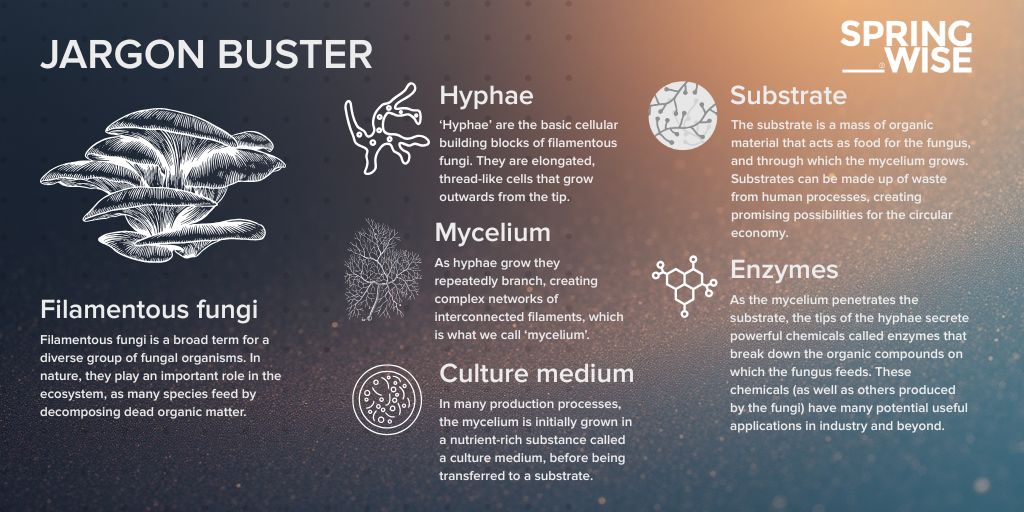
Mycelium is the part of a fungus that is often likened to the roots of plants. In nature, mycelium networks spread out through the soil, breaking down organic matter into nutrients. Unlike animals that must first ingest (i.e. swallow) their food before they can digest it, the reverse is true for fungi – their food must first be broken down into simple molecules that can be absorbed through the walls of their cells. Fungi do this by secreting powerful chemicals, known as enzymes, from the tips of the filaments that make up mycelium, and these can be leveraged by humans.
Why is it exciting?
Because of their “unique and potent enzyme system”, fungi are excellent at breaking down really tough materials that other organisms struggle with, such as the lignocellulosic material found in woody biomass. This ability is useful to us in numerous contexts (such as in advanced plastic recycling and pollution remediation).
Mycelium also binds organic particles together as it degrades them, an ability that can be leveraged to create mycelium composite materials that consist of organic matter ‘glued’ together by mycelium filaments. Finally, one specific type of fungi, mycorrhizal fungi, obtain sugars via beneficial relationships with plants, exchanging them, via their mycelia, for moisture and soil nutrients. These fungi help to maintain plant and soil health, which has positive impacts in areas such as nature-based carbon sequestration and agriculture.
“Fungi have an inherent ability at which they excel, which is using pollutants as a food source – because that's their niche in ecology.”
Max Nijman, co-founder and CTO of MycoFarming
“Fungi know how to recycle very well and mycelium, in particular, excretes enzymes that are very efficient at recycling toxins.”
Joanne Rodriguez, CEO of Mycocycle
What are the main applications?
Alternative proteins
Quorn is perhaps the most established mycelium brand on the market, having been launched in the 1980s. However, there continues to be innovation in the use of fungi and mycelium for alternative proteins (a.k.a. meat replacements). The basic cellular building blocks of mycelium, called hyphae, can be arranged to create a structure that looks like, and has the mouthfeel of, meat – particularly chicken.
Mycelium can also be used as a support structure in cultivated meat production, where meat is grown from animal cells in a lab.
Packaging
Another of the more established mycelium applications is packaging, particularly foam protective packaging that can replace polystyrene. These packaging innovations take advantage of the inherent bonding properties of mycelium as well as its biodegradability.
Mycelium packaging production typically uses custom growing chambers and moulds to shape the packaging into the desired shape. These moulds are often made in-house, meaning that startups in this space require expertise in 3D modelling and 3D printing.
Forest carbon and agriculture
More than 250,000 plant species are associated with mycorrhizal fungi, forming symbiotic relationships through their root systems. These fungi-plant connections are “vital for the soil structure, nutrient cycling, plant diversity, and ecosystem sustainability.”
Fungi also play a crucial role in natural carbon sequestration, with University of Sheffield researchers finding that fungi store one-third of carbon from fossil fuel emissions.
Given the importance of mycorrhizal connections, several innovators are using fungi to support nature-based solutions like tree-planting. Others are attempting to leverage these relationships to boost crop yields.
Fashion
Another emerging application for mycelium is as a replacement for synthetic textiles and animal-based leather. Mycelium leather has a much shorter production period than animal leather, while also avoiding ethical issues associated with animal husbandry.
Mycelium could also be used to create other types of textiles, fabrics, and clothes. As with mycelium packaging, a key benefit of mycelium textiles is their biodegradability, which promises to address some of the environmental impact associated with today’s non-biodegradable synthetic fibres.
Construction materials
Beyond the clothes we wear, innovators are exploring how mycelium can be used as a building material. Mycelium’s ability to bind together the biomass it feeds on makes it possible to create mycelium-based composites. These ‘MBCs’ combine the mycelium itself with feedstock materials that can be sourced from waste streams, creating a circular solution. Shaped into bricks or panels, MBCs could be used as an alternative to carbon-intensive building materials in multiple applications.
MBCs offer recyclability and low-energy production, in addition to providing a use for typically unrecycled waste. They also have further beneficial properties, such as fire resistance. On the other hand, a current limitation of mycelium-based materials is their typically low tensile strength. As a result, they are mostly being used for applications such as thermal and acoustic insulation, rather than more structural use cases.
Pollution remediation
For millions of years, fungi have played a crucial waste management role within ecosystems due to their ability to break down dead biomass, including more complex compounds like lignin. Innovators are now leveraging this ability to tackle human-made pollutants in both soil and water, a process known as ‘mycoremediation’.
Mycoremediation works through multiple mechanisms, such as biodegradation, biosorption, and bioaccumulation.
One of the exciting features of mycoremediation is that it can produce useful end-products, such as food, feedstock, or fertiliser, thereby turning harmful waste into something valuable.
What startups are developing mycelium solutions?
The Springwise Take
At the most basic level, mycelium is exciting as a climate solution because it has three fundamental abilities: it can break larger compounds down into simpler ones, it can bind organic material together, and it can act as a carbon sink. These adaptations are the result of millions of years of evolution and are useful to us as we tackle our interconnected planetary crises. They also allow for a wide range of potential applications across many sectors of the economy.
The big promise of mycelium is that it could enable us to create greener, cleaner industrial processes that consume less water and emit less carbon than our existing petrochemical-reliant systems.